A shipping container library
building a personal library that you don’t have space for at home 2026-07-21 #books
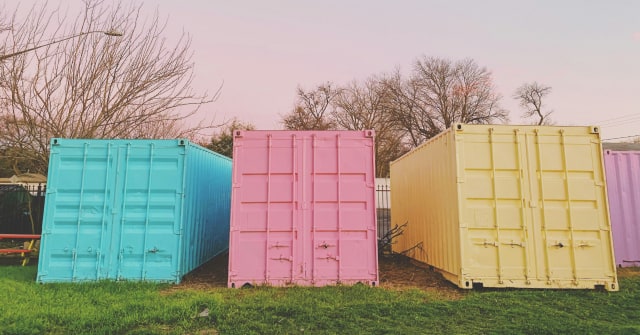
- Shipping container library ←
- Library layout
- Library capacity
- Community libraries
As hobbies go, reading novels hardly costs anything at all. You have zero start-up costs, assuming that you already know how to read, and physical books don’t require additional hardware. You can buy books one at a time, and they take a while to read.
Reading novels can escalate, and you might start stocking up on unread books, and browsing the IKEA catalogue for additional bookcases. By the time you end up with ‘too many’ bookcases, you should have already carefully chosen your great-grandparents, and inherited a substantial castle, or at least a large house. Otherwise, you need an alternative plan.
Collecting books
Reading physical books and keeping them when you finish reading them eventually turns a cheap hobby into an expensive one. It doesn’t happen overnight, but after a few years, reading several books a month means finding room to keep them.
Most people draw the line after the first few bookcases, and adopt a one-in-one-out book policy, or at least systematically give them away. If you don’t do this, and accept that you now collect books as well as reading them, you need to start planning space for a personal library. For example, you could:
- reclaim space used for television, hi-fi speakers, and other electronics,
- earn enough to move to a bigger home with more bookcases, or
- take up carpentry and get creative with squeezing in more bookcases.
As a thought experiment, maybe you can figure out another option.
Architectural shipping containers
Shipping containers have all sorts of alternative architectural uses. Perhaps their ubiquity and room-sized scale naturally lead us to imagine fantasy modular labyrinths that grow container-by-container. And if you’ve ever visited a self-storage facility where you rent a shipping container, perhaps you’ve imagined how each one might contain something more interesting than cardboard boxes of household junk.
You could pack an escalating book collection in cardboard boxes, and rent a self-storage shipping container to keep them in. But that sounds both tragic and impractical. You wouldn’t get to look at your books whenever you want, and you’d miss them, even if they don’t miss you back. You’ll (maybe) unpack them again one day, but until then, you’d find it difficult to retrieve a specific book.
Minimum viable shipping container library
Once you’ve got a shipping container, you could fill it with bookcases instead of cardboard boxes. A standard 20-foot ISO intermodal container has interior dimensions 5.867× 2.330 × 2.350 m, and an IKEA BILLY bookcase measures 0.80 × 0.28 × 2.02 m. Therefore, to start with, you could place 16 BILLY bookcases against the walls (7 along each side and two at the back).
That doesn’t use the interior space well, though, because you probably don’t need more than one metre of space in front of each bookcase. For example, you could probably use a series of U-shaped alcoves to increase the number of bookcases. I’ll leave finding the bookcase arrangement that maximises the BILLY factor as an exercise for the reader. Don’t forget to leave space for an armchair and a drinks cabinet.

