Shipping container library capacity
booksmaxxing by numbers 2026-08-04 #books
- Shipping container library
- Library layout
- Library capacity ←
- Community libraries
In your personal shipping container library, an interesting layout would accommodate 21 BILLY-equivalent bookcases (one standard IKEA BILLY or two half-width BILLY bookcases). But bookcases merely offer a means to an end: room for lots of books. Therefore, you also need to know how many books would fit in your shipping container library.
Books per shipping container
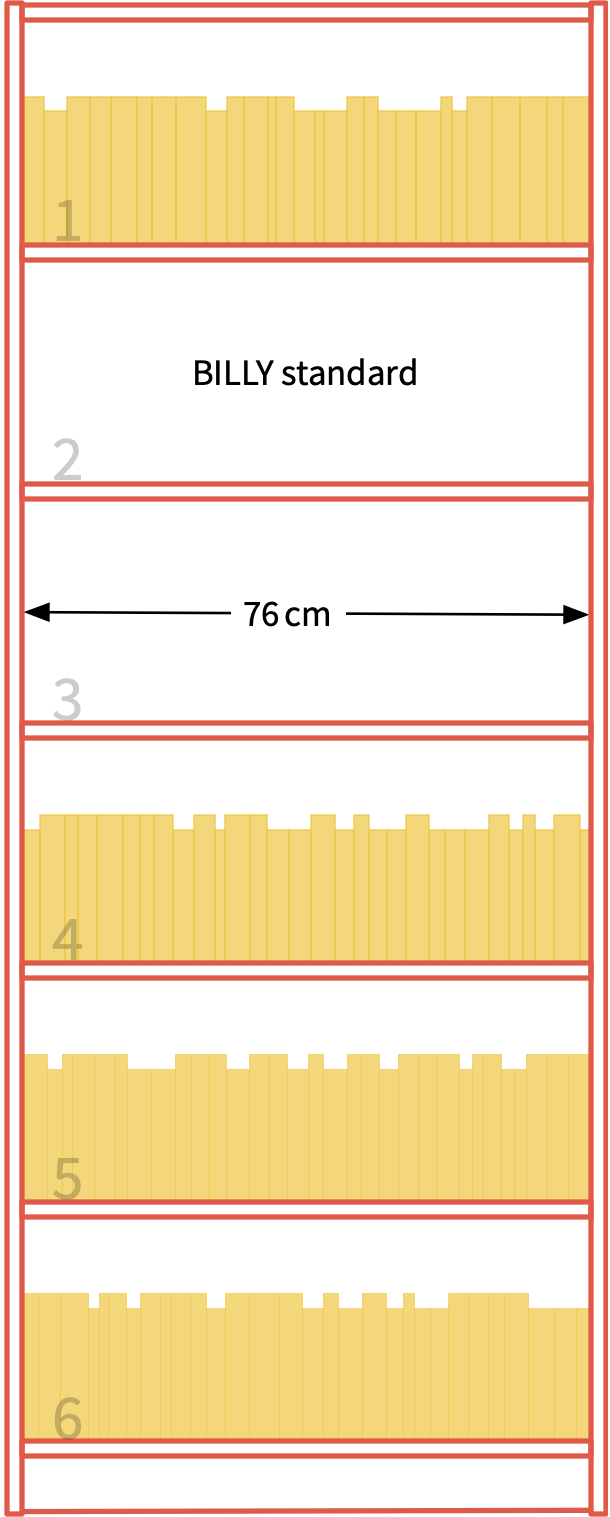
A standard BILLY bookcase has six shelves, each 76 cm wide. Meanwhile, paperback books have an average thickness of 22–25 mm, with variation in the number of pages, paper thickness, and cover thickness.
The average number of pages per book probably varies by genre, and therefore by personal collection. Ignoring that gives a capacity of roughly:
- 32 books per shelf
- 42 books per bookshelf-metre
- 6 × 32 ~ 190 books per bookcase
- 21 × 190 ~ 4 000 books per shipping container
To put that in perspective, 4 000 books gives you reading material for one book per week for 77 years.
While this certainly sounds like enough for a personal library it also depends, for example, on how many unread books you accumulate. To play it safe, make space for even more books in each bookcase.
Additional shelves
Evenly-spacing the six shelves in a standard BILLY bookcase leaves around a 30 cm vertical gap between shelves. This wastes vertical space above each row of paperbacks, because standard paperback heights cluster around 20 cm:
- 110 × 178 mm A-format ‘mass market’ paperback
- 129 × 198 mm B-format paperback
- 152 × 229 mm hardback or trade paperback
Fortunately, you can customise your BILLY, with an extra shelf or two, and adjust the vertical shelf spacing. In theory, you could evenly space nine shelves of A-format paperbacks, or eight shelves of B-format paperbacks, leaving around 2 cm space above each book, for access:
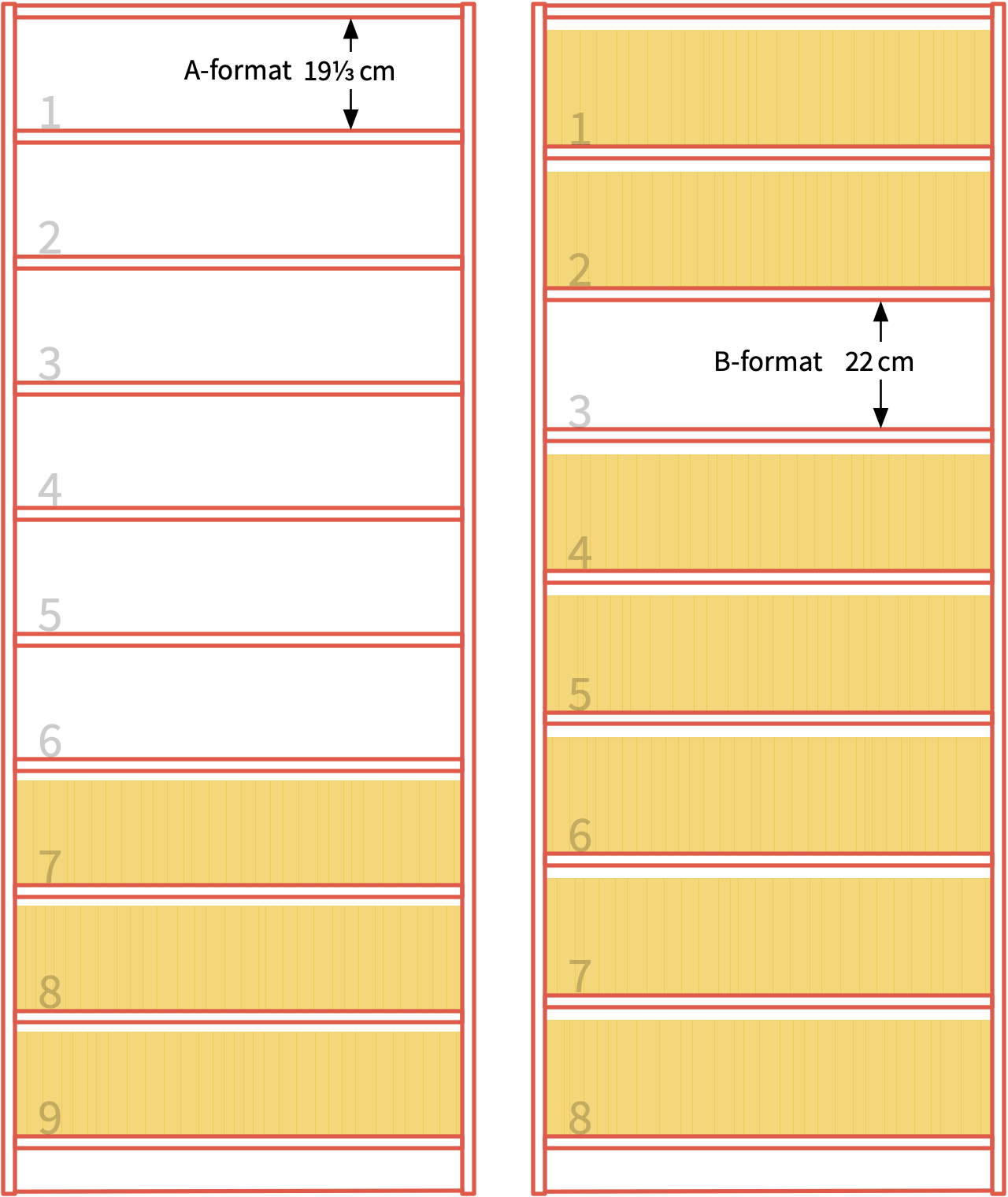
Unfortunately, a BILLY doesn’t give you quite that much flexibility.
Shelf position constraints
Although you can adjust the position of its shelves, a BILLY bookcase has several constraints, assuming that you won’t drill additional adjustment holes:
- you cannot move the middle shelf, halfway up, as it forms part of the rigid structure
- you can only adjust vertical position in 32 mm steps
- the top, middle and bottom shelves don’t have nearby adjustment positions.
The third constraint doesn’t matter, in practice, because it makes the minimum vertical space 14 cm (top and bottom shelves) or 10.8 cm (around the middle shelf), both less than a small paperback.
Book size mix
With the shelf-position constraints, you can fit eight shelves by alternating between enough vertical space for B-format and A-format books (below, left).
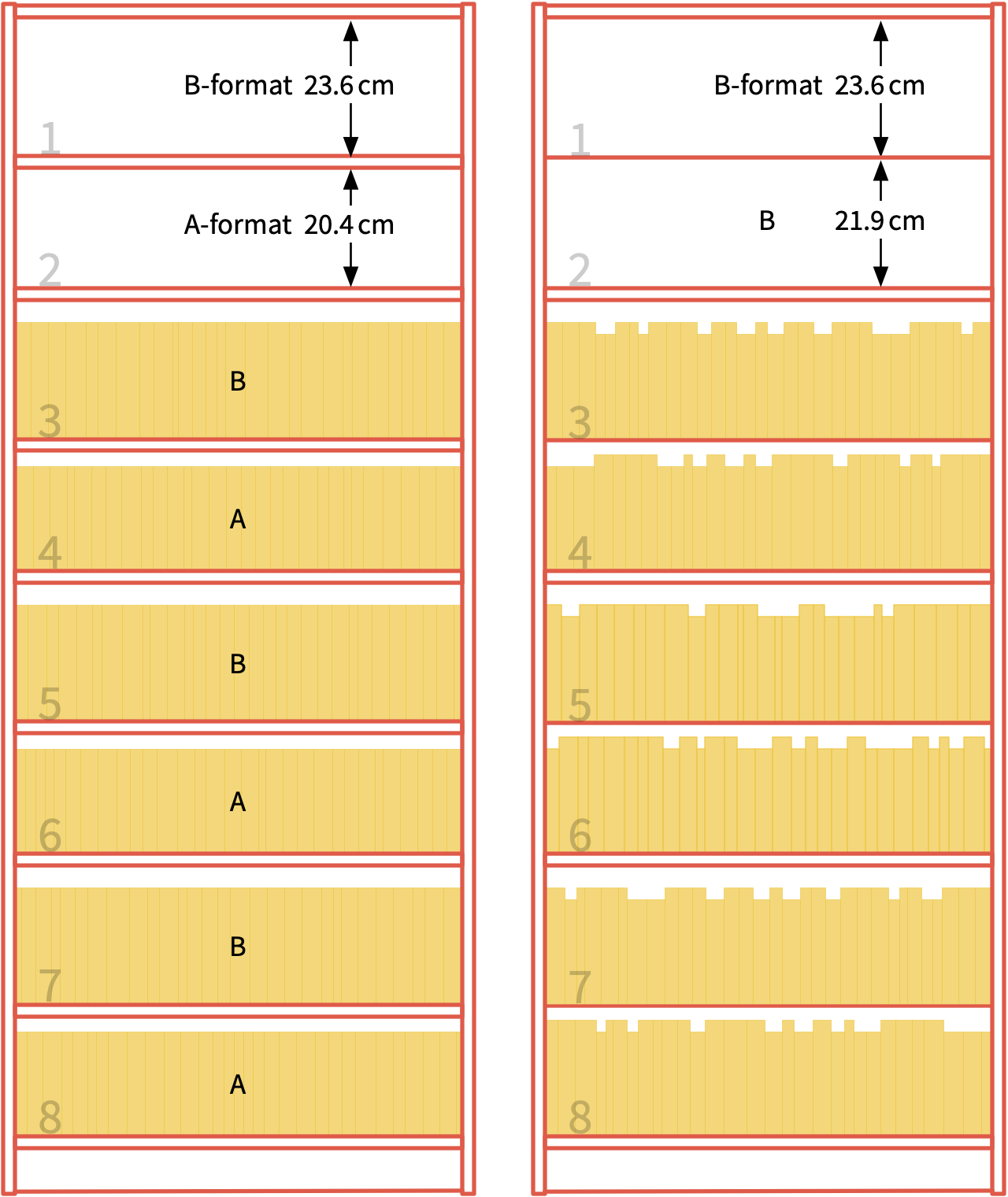
However, I don’t have enough A-format paperbacks to fill half of the shelves. I have mostly B-format fiction paperbacks, a smaller number of A-format paperbacks, and few hardbacks and larger paperbacks. I avoid the latter, because they hurt too much when you fall asleep while reading in bed and drop the book on your face.
You can make room for B-format paperbacks on every shelf if you replace half of the shelves with a BILLY glass shelf (above, right), which saves 1.5 cm of height. This shelf can handle a maximum load of 10 kg, but 80 cm of only B-format paperbacks seems to weigh about 9.2 kg, so that probably works.
Shipping container library capacity
Either way, you get a lot more shipping container library capacity: eight shelves per bookcase increases capacity to 8 shelves × 32 books × 21 bookcases ~ 5 400 books. With this much capacity, it feels like a waste not to share it.

