Book review: Isaac Newton
James Gleick’s story of renaissance philosophy and mathematics 2026-07-14 #book
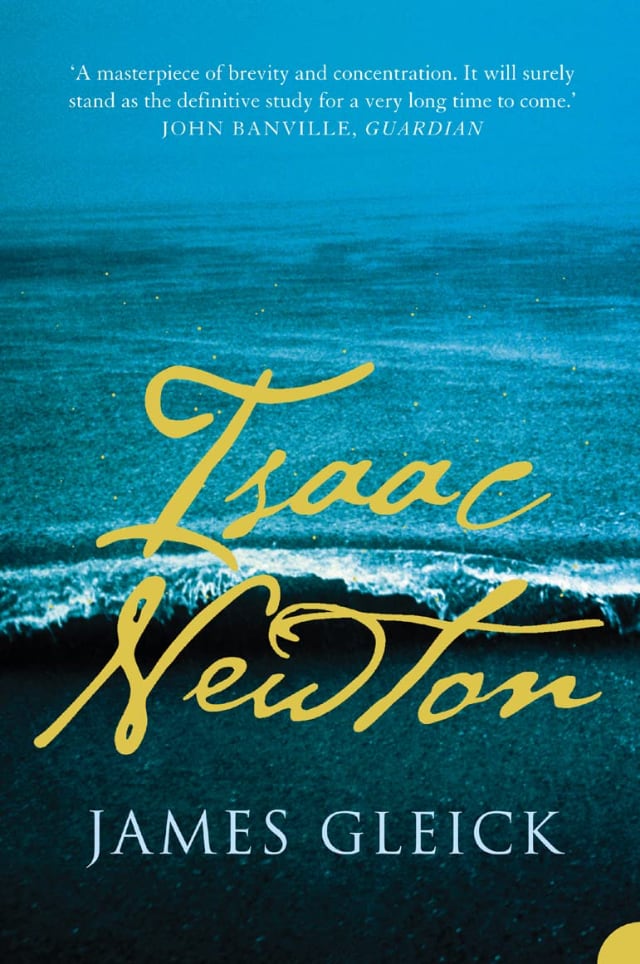
James Gleick introduced me to excellent popular science writing when I read his first book, Chaos: Making a New Science, as a teenager. At the time, it inspired me to focus my A-level mathematics coursework project on chaos theory, and introduced me to computational mathematics.
Since then, I’ve hardly read any science history, but couldn’t resist Gleick’s 2003 book, Isaac Newton, when a copy came my way. Unsurprisingly, I enjoyed it. The contents did surprise me, though, because I knew a lot less about Newton the man, than about his mathematical legacy.
The curse of knowledge
I recently read Made to Stick, in which the villain of the story conspires to prevent us making messages stick. The curse of knowledge – the antagonist – makes it hard to imagine someone’s perspective when they don’t know what we know.
Isaac Newton (the book) starts with the story of an isolated man who struggled with everything he didn’t know. The curse of knowledge makes it hard to imagine thinking about motion and gravity in the 1660s, when contemporary thought held that the moon had no substance, or that it exerted pressure on the sea. Gleick tells how Newton’s context differed so much from how we now think – from Newtonian physics, and how he reasoned that understanding planetary motion required new kinds of mathematics.
The infinite and the infinitesimal
I liked how this book framed Newton’s struggle to apply mathematics to motion. The book describes the challenge of imagining infinite and infinitesimal quantities, rather than the actual mathematics. Of course, I didn’t enjoy studying calculus at university, having had too little of it at school (instead ‘wasting time’ on more interesting topics such as chaos theory).
Rather than explain the mathematics, Gleick explains Newton’s difficulty in navigating between his religion and other people’s opinions. Throughout the book, the story returns to Newton’s reclusive nature, and how he avoided meeting people to talk about his work, or even publishing it.
Scientific publication
Much of Gleick’s account tells the story Newton, secluded in Cambridge, in private correspondence and public conflict with members of the Royal Society in London. This human drama fascinated me, especially because it hinged on Newton hiding his mathematics, and for years refusing to publish.
Newton published his great work, the three books of the Principia. Gleick writes:
When the seventeenth century ended, the published work of Isaac Newton amounted to little more than three hundred copies of the Principia, most in England, a few scattered on the Continent.
It turns out that we take more for granted than Newton’s theories, such as calculus and his laws of motion. Today, scientific publishing has plenty of problems, but at least modern scientists have to publish to succeed.
Isaac Newton
I would have found this book about Newton interesting if it had only described the scientist, and his work. But more than that, I enjoyed learning about Newton’s difficult relationships with other people, and the contemporary thinking he had to break away from.
⭐️⭐️⭐️⭐️⭐️ Recommended.

