Book review: Made to Stick
memorable messaging by Chip & Dan Heath 2026-06-30 #book #review
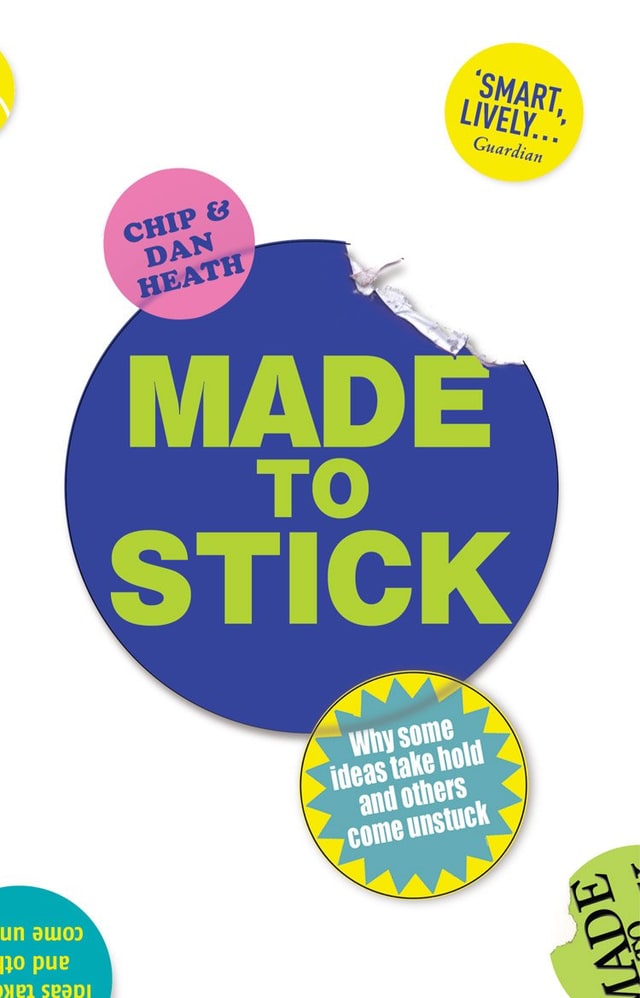 Made to Stick, by Chip & Dan Heath, explores why we forget some ideas and stories, and remember others.
Some explanations, especially at work, just don’t stick, despite including all of the right information.
Made to Stick, by Chip & Dan Heath, explores why we forget some ideas and stories, and remember others.
Some explanations, especially at work, just don’t stick, despite including all of the right information.
Naturally, this book does a great job of telling a memorable story. And like many pop psychology and business books, it has a framework that adds structure to a series of interesting and entertaining anecdotes.
The framework
The first chapter introduces six principles (properties) of sticky ideas:
- simplicity
- unexpectedness
- concreteness
- credibility
- emotions
- stories
Each of these then gets a chapter to break them down further. As a result, anyone who likes a nicely organised framework gets plenty of structure to chew on.
The last chapter includes some nice repetition, to take it back to the book’s principles. There, we rediscover that we can make our audience:
- pay attention (to unexpectedness)
- understand and remember (to concreteness)
- agree or believe (credibility)
- care (about emotions)
- manage to act (on stories)
This 2008 edition includes bonus repetition, with an epilogue that applies the framework to talking about business strategy, teaching, and ‘unsticking’ ideas we don’t like. And after all of that, a five-page easy reference guide summarises the book’s key ideas.
Framework fatigue
I enjoyed reading Made to Stick. I definitely like books like this to have so much structure, because of how it makes them both easier to read and to refer back to. But I also can’t help wondering if this doesn’t give me some kind of framework fatigue.
By contrast, reading non-fiction with less obvious structure feels less like studying a textbook. This can go either way. Well-written examples tell a story without directing so much attention to their structure, with no contrived frameworks or acronyms in sight. Other books become a struggle, and feel too long and dense.
What sticks
After reading Made to Stick, I definitely recommend it to anyone who has to craft and spread a memorable idea, such as a product strategy. This much of the book has clearly stuck.
Having finished the book, I can’t help also wondering about what I want out of the non-fiction I read. While entertainment doesn’t feel like the right word for what I want, I miss the unexpected associations of less structured writing. Unexpectedly, perhaps, Made to Stick covers this too.
Stories
Storytelling offers a creative escape from the book’s more structured parts of the framework. But even the chapter on stories fits into the framework. It explains how stories work as a kind of mental simulation, and that these simulations drive action, while stories’ inspiration also does.
Stories have their own structures and stereotypes, of course. But perhaps the familiarity of story templates like the hero’s journey makes their structure intrude less on the stories that use them. In the end, Made to Stick achieves what it sets out to do, even if it feels like I’ve read too many books like it.
⭐️⭐️⭐️⭐️ Cautiously recommended.

