Document trade-offs and compromises
Northern Europe’s crimes against Italian cuisine 2025-12-16 #documentation #cooking
- Failure & recovery
- Specific techniques
- Substitutions
- Roles
- Small tasks
- Quantities
- Variants
- Trade-offs ←
A 2018 YouGov survey reported that everyone around the world likes Italian cuisine, and in December 2025, UNESCO added Italian cooking to the Representative List of the Intangible Cultural Heritage of Humanity. Unfortunately, YouGov’s 2021 survey reported that everyone does Italian food wrong. This didn’t happen because of Italian recipes’ difficulty. This happened because everyone makes different trade-offs and compromises, but not explicitly.
Italian cooking
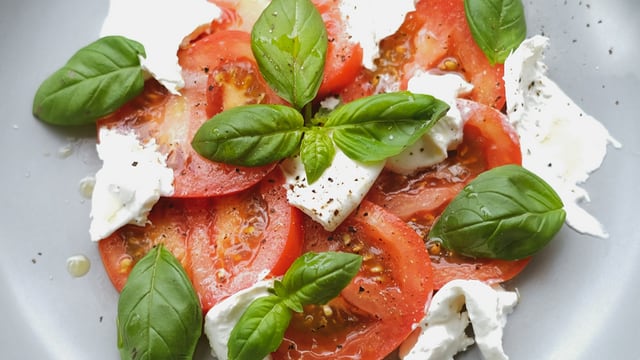
In Italy, the Caprese salad (photo, above) consists of four ingredients, arranged simply on a plate: mozzarella, tomato, basil, and olive oil. Italian cooking looks like painting with primary colours: if not the Italian flag’s, then like those of a 1980s shopping centre, as opposed to a Scandinavian furniture shop’s shades of brown and grey.
This simplicity characterises many classic Italian recipes. Like cocktails, they combine few ingredients, often with minimal preparation. The problem with actual Italian cooking occurs earlier in the process, before this preparation.
Note that Italian cooking doesn’t even exist, in the sense that everything about it varies between regions, with especially large differences between the North and South. However, attempting to focus on a single region of Italy only makes the shopping problem worse.
The shopping problem
Italian cooking relies on the quality and availability of the fresh ingredients, and barely uses the spices that appear in other Mediterranean cuisines. This leaves those of us in colder Northern European climates with several options, when attempting an Italian recipe.
- Fly to Italy, and buy fresh local ingredients at a food market.
- Buy preserved ingredients, imported from Italy.
- Use relatively bland Northern-European ingredients (that at least look okay in photos).
- Adjust Italian recipes to build richer flavours, using local ingredients.
- Abandon the attempt to prepare recognisably-Italian food.
For example, a ‘Caprese salad’ outside Italy will often include additional stronger flavours, such as olives or balsamic vinegar, to compensate for bland tomatoes. Either way, you get to choose a compromise from among these options. Some of them will annoy Italians, or disappoint your guests, though. When you cook Italian food outside Italy, you have to make trade-offs.
Trade-offs
Flying to Italy to buy cooking ingredients has a shocking cost, while using ingredients from your local Northern Europe supermarket may lead to disappointing results. Buying a mixture of fresh and preserved ingredients from a local Italian delicatessen, if you have one, probably falls somewhere in between.
When you cook Italian food in Northern Europe, you make a number of trade-offs when you shop for ingredients, including:
- time
- money
- environmental impact
- flavour
- authenticity
- novelty
You can’t please everyone: when you make trade-offs, you have to choose a compromise. To set expectations, you can at least explicitly state which trade-offs you make.
Software trade-offs & documentation compromises
Building software doesn’t have a lot to do with cooking, but both give you more than one way to do it. Software design and product management enjoy an infinite hypermarket of ingredients and recipes, and just as many trade-offs and compromises.
Software documentation typically focuses on how things work, often as a contingency for poor user experience design. If you do manage to produce software whose usability makes a manual unnecessary, it can still benefit from explanations about why it does what it does. And maybe then you’ll even get fewer complaints about what it doesn’t do.

