Track unread books
solving another domestic inventory management problem 2026-01-13 #books #reading
- Unread books
- Unread bookcase
- Curating unread books
- Track unread books ←
- The StoryGraph
When you curate an unread books collection, you improve your reading habit’s physical supply chain. This includes both inventory management opportunities and problems.
Inventory management optimisation
An unread-books bookcase adds flexibility to what you can read next. In inventory management terms, accumulating unread books creates two optimisation opportunities.
- Maintain a minimum stock level (of unread books), to prevent an unexpected stockout (not having anything to read)
- Use inventory to decouple purchasing from consumption (reading), to enable cost optimisation, by waiting until you can purchase for less than previous average price (secondhand bargains).
However, having many unread books introduces a new complication. Inventory opportunities come with inventory problems.
Inventory management problems
I love adding a book to my unread-books bookcase, especially when I complete an unread trilogy that I can now start. However, I don’t love finding the correct location to add a new book, and discovering that I already have a copy.
When you have more than a few dozen unread books, you need a way to avoid acquiring duplicates. This doesn’t usually happen with books you’ve read, because you probably remember reading them. Buying a book (without reading it) may prove less memorable. To solve this information problem, you need a way to keep track of unread books.
Inventory visibility
At home, I have my unread bookcase in the bedroom, next to the bed. Every morning, I can’t help scanning the shelves, so I can probably remember ‘half’ of my unread books. This doesn’t cost any additional effort, but I want to do better than halving book duplication risk.
If I could somehow free up a whole shelf (obviously unrealistic), I could highlight recent acquisitions, to make them more memorable. The new arrivals shelf would show the latest half-dozen acquisitions forward-facing, the way bookshops promote certain books. But I still wouldn’t have memorised the contents of the whole bookcase.
Minimal stock list
To avoid duplicate-book disappointment, explicitly track every unread book you have, at least in a minimal stock list. For example, list unread books, move a title to a Reading section when you start it, and then on to Read when you finish. In Apple Notes, you’d have the following, automatically synchronised between mobile and desktop:
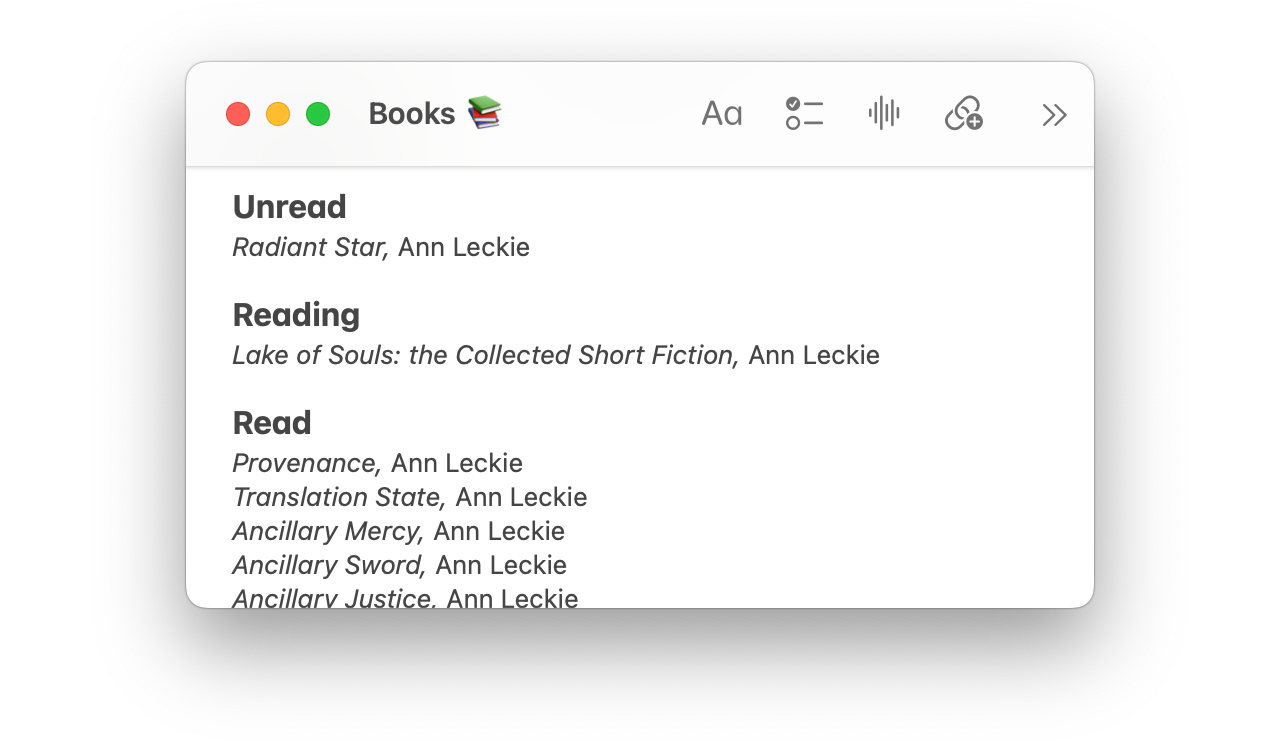
You don’t need to list more than title and author to search for potential duplicates. You might find it satisfying to add publication year, ISBN and a link, but no more satisfying than other kinds of reading procrastination. I like to have a Read section per year, each with a numbered list, so I can see how many books I’ve read.
Note: the list doesn’t have to only contain Ann Leckie’s books, although I do recommend that particular science fiction. And if you do mix genres, you could indicate them with emoji.
Special-purpose inventory management systems
Online book trackers let you look up books, make your own lists, read and write reviews, browse recommendations, follow friends’ reading, embrace gamification, and buy books from associated web shops. Book lovers have their own social media, with all of the features.
Personally, I don’t need to use a book tracker, but I do anyway. The simple book inventory list does everything I need, but a fancier user interface has something extra. I probably just like seeing the book covers.

